
College Park currently receives police services through a multi-layered system led primarily by the Prince George’s County Police Department (PGPD), supplemented by City-funded programs and other specialized agencies. PGPD provides core services, including patrol, dispatch, and investigations, funded in part through property taxes paid to the County.
The $4 Million PGPD Patrol Service
PGPD patrol services provide police coverage in College Park. We receive these services in exchange for the taxes we pay to the County. According to the Prince George’s County Office of Management and Budget (OMB), College Park residents and businesses will pay approximately $4 million annually in FY2027 through the County tax differential to receive PGPD patrol services, including limited investigative support.
PGPD dispatch services are handled through the County’s Emergency Communications Center (ECC), which manages all 911 and non-emergency calls countywide. This is a separate program within the County’s operating budget and is not part of the PGPD patrol budget. SWAT, gang units, and other specialized services are also funded through the countywide police budget, not through the patrol tax differential.
As shown below, it appears that our residents are not receiving a level of PGPD patrol services that corresponds to the taxes they pay to the County. And there are good reasons why that is not happening – please read more on that below.
Because of the limited patrol coverage provided in College Park through PGPD patrol services, the City established its own contract police program, staffed by off-duty PGPD officers working various shifts and hours. The contract program is funded separately through the City’s general funds. However, the discussion regarding the contract police program is a separate topic. The focus of this article is the PGPD patrol services for which our residents pay approximately $4 million annually.
How Much Services We Get as Part of Patrol Services?
Let’s break down more on the PGPD patrol services cover services provided by the patrol officers, COPS officers and investigation services.
(1) Patrol Officers: For patrol services, only two PGPD patrol officers are assigned to Beat Areas 6 and 7 to provide primary coverage for College Park. They patrol our streets and respond to 911 calls.
(2) COPS Officers: Additionally, two Community Oriented Policing Services (COPS) officers—one assigned to each beat—provide services such as the Police Explorers program, the Citizens’ Police Academy, and other community outreach initiatives. Their primary role is not street patrol, but rather enhancing community policing efforts.
These beats are part of District 1 (Hyattsville), which serves a geographic area extending beyond the City’s municipal boundaries. Beat 7 covers north College Park, along with a large portion of Greenbelt and a small section of the Beltsville area. Beat 6 covers south College Park and also includes areas within the Town of University Park and the City of Riverdale Park, extending east of Kenilworth Avenue.
Because the areas outside of College Park have their own police departments, PGPD beat and COPS officers do not actively patrol those jurisdictions. However, they do spend time coordinating with the respective municipal police departments on incidents originating within those portions of Beats 6 and 7.
In some situations, PGPD beat officers also provide coverage in areas outside College Park within their assigned beats when sufficient staffing is not available from the municipal police departments operating in those jurisdictions.
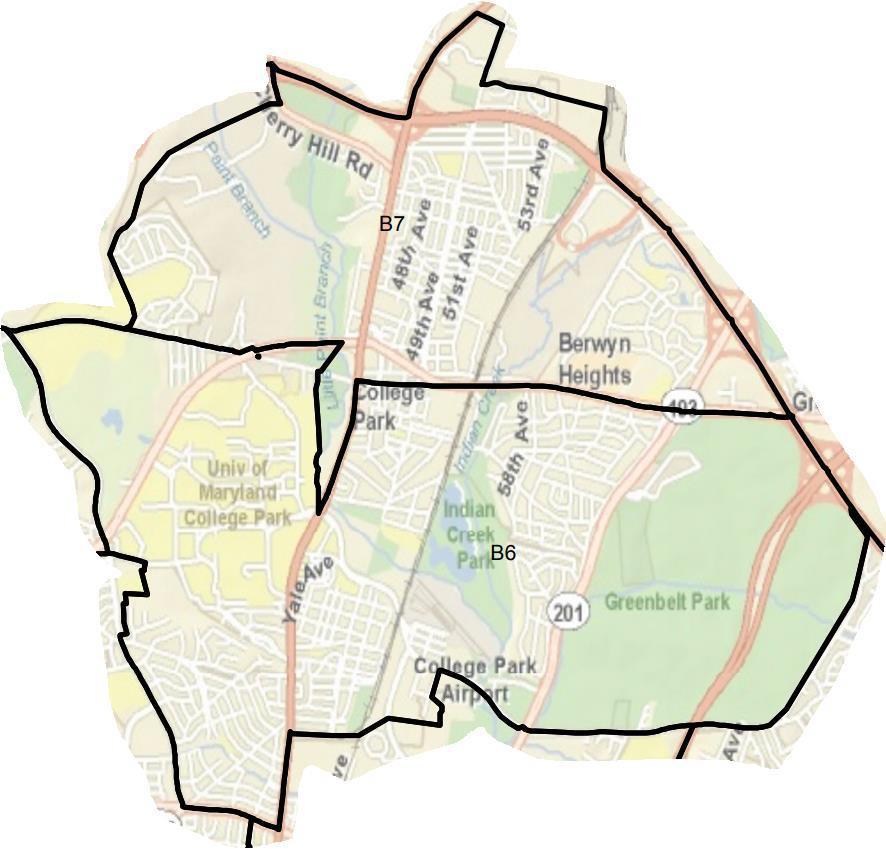 PGPD Beat Maps (B6 & B7). Source
In a typical 24-hour period, four PGPD beat officers cover the two beat areas serving College Park through two 12-hour shifts. This is equivalent to 48 hours of service per day, or 336 hours per week. The two COPS officers work one 10-hour shift, four days a week, which is equivalent to 80 hours per week. In total, these officers collectively provide approximately 416 officer-hours of service over a one-week period. This is equivalent to roughly seven officers working standard 8-hour shifts in a single day.
(3) Investigation / Detective Services: The amount of investigative and crime analysis services that College Park receives as part of PGPD patrol services is not readily available. Based on national benchmarks from the U.S. Department of Justice, a typical police department allocates approximately 8%–12% of its sworn officers to investigative functions. Accordingly, we can assume that no more than the equivalent of one full-time officer is dedicated to investigative services for College Park.
Based on the above analysis, the overall level of service increases to approximately eight officers working standard 8-hour shifts. Because these officers patrol areas larger than the City of College Park and are assigned throughout the broader District 1 area, the actual time dedicated exclusively to the City is likely somewhat less than these equivalents. In reality, the number is probably closer to seven officers covering College Park in 8-hour shifts.
Also, let’s not forget that even though we receive investigative and COPS officer support, at any given time we are getting only about two police officers actively patrolling our streets.
Are Residents Getting What They’re Paying For?
We probably do not need an exhaustive police study to understand the level of police services that a $4 million annual budget could provide. Looking at the police budgets and staffing levels of nearby municipalities can already give us a reasonable picture of what that level of funding is capable of supporting.
Several cities and towns surrounding College Park operate their own municipal police departments with annual budgets that are at or below the approximately $4 million patrol services tax differential currently associated with College Park residents and businesses. As shown in the table below, some of these municipalities are able to maintain significantly larger police staffing levels and more direct local patrol coverage with budgets that are substantially less than $4 million.
| City | Annual Police Budget | Sworn Officers | Total Staff |
|---|---|---|---|
| Berwyn Heights | $1.1M | 10 | 11 |
| District Heights | $1.3M | 10 | 11 |
| University Park | $2.0M | 9 | 11 |
| New Carrollton | $3.7M | 17 | 20 |
| Riverdale Park | $5.0M | 23 | 30 |
These comparisons suggest that there is indeed a considerable gap between the level of police services College Park residents are currently receiving and the amount of funding generated from the community for primary police patrol services.
The presence of the City’s 15.5 FTE contract police program also contribute indirectly to residents not receiving a level of County police resources equivalent to what they pay for, because the program helps reduce the City’s crime rate and call volume. Please note that College Park does have its share of crime, averaging about 500 non-violent crimes and 100 violent crimes annually, not including crimes reported by the University of Maryland Police (UMPD). We also receive many requests from residents to increase patrols on their streets. Therefore, additional resources to help our residents feel safer would only be appreciated.
This does not necessarily mean that PGPD is failing to perform its duties. Rather, it reflects the reality that PGPD allocates resources countywide based on call volume and operational priorities, not based on the amount of tax differential revenue generated by individual municipalities.
The question for College Park residents and policymakers is therefore a broader policy question: whether the current structure provides the best value and level of service for the community, or whether a different model could provide more direct local policing resources, greater accountability, and more responsive service using the same funding stream.
The Gap Issue Will Worsen In Future Years
The gap between what College Park residents pay and the level of police services they receive is likely to continue widening in future years. This trend is already evident from the City’s significant economic growth over the past decade.
From FY2018 to FY2027, College Park’s tax base—the total assessed value of taxable property in the City—grew by approximately 75%, increasing from about $2.4 billion to roughly $4.2 billion.
This growth has substantially outpaced inflation and increases in labor costs in many sectors, creating additional fiscal capacity over time. As the City’s tax base has grown, so has the amount of tax differential revenue generated from College Park residents and businesses for primary police services provided by the Prince George’s County Police Department (PGPD).
However, while the tax revenue associated with College Park has increased significantly, the level of PGPD patrol staffing allocated to the City has not increased proportionally.
As a result, unless there is a major shift in PGPD’s resource allocation policy, the gap between the taxes paid by College Park residents and the police services received by the community will likely continue to grow in the years ahead.
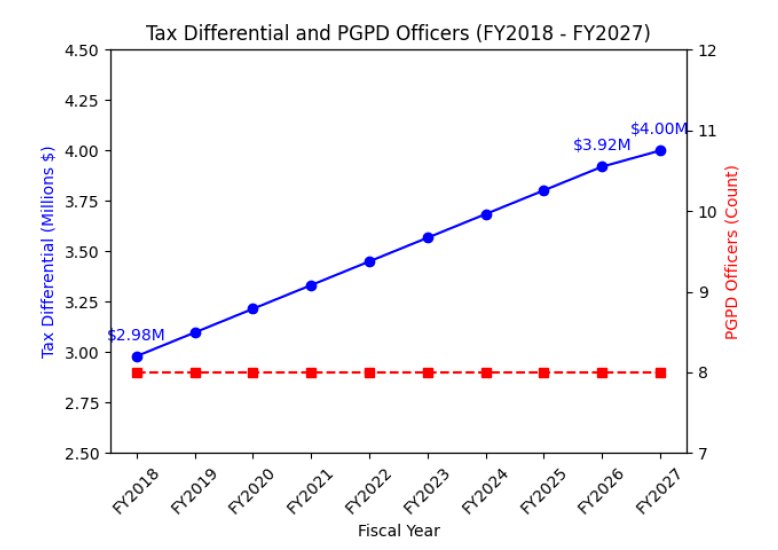 Trends in Tax Revenue Differential and PGPD Police Staffing Levels
How to Address the Gap Between Taxes Residents Pay and Services They Get?
One possible solution is for the Prince George’s County Police Department (PGPD) to increase the level of police services provided to College Park so that it better reflects the taxes our residents pay. Unfortunately, based on PGPD’s long-standing policy on resource allocation to jurisdictions without municipal police departments, this is unlikely to happen.
PGPD allocates patrol resources primarily based on call volume and crime trends—not on the amount of taxes collected from residents in a particular municipality. Because College Park’s call volume and crime rates have remained relatively steady over the years, we should not expect a significant increase in police staffing or patrol coverage simply because the City now contributes substantially more tax revenue to the County.
A few months ago, I personally raised this concern in a letter to our County Executive. However, I do not expect PGPD’s allocation model to change, and frankly, I do not believe PGPD is at fault. The department appears to be applying its policy consistently across the County.
The other option to address this growing gap between the taxes residents pay and the police resources allocated to our community is to utilize the approximately $4 million patrol services tax differential and establish a small municipal police department, similar to other municipalities in Prince George’s County.
Doing so could not only address the current imbalance, but also provide several additional benefits, including greater local control over policing priorities, faster response to community concerns, and more direct accountability to College Park residents. In many small municipalities, police officers are viewed as trusted members of the community—residents know them personally and often see as partners and family friends. This type of community-oriented policing can help build stronger relationships, improve trust, ensure that local concerns are heard, and create a more positive and responsive public safety environment.
One of the biggest advantages of having a city police department is local control, which often leads to better responsiveness and quality of service. We already see this in other areas — for example, our City Public Works does a much better job with services like snow removal compared to many unincorporated areas of the county. The same principle can apply to policing: when services are managed locally, residents typically receive more focused attention, greater accountability, and services better tailored to the community’s needs.
Importantly, this would not necessarily require additional recurring dollars to operate the department annually, since the funding would come from the existing tax differential already generated by College Park residents and businesses. While there would certainly be one-time startup and capital costs associated with establishing a municipal department, those costs should be viewed as a long-term investment in improved local public safety, stronger community policing, and greater local control over policing priorities.
Mary Hartnett
Rather, it reflects the reality that PGPD allocates resources countywide based on call volume and operational priorities, not based on the amount of tax differential revenue generated by individual municipalities.
This is why CP will never get more bang for its buck and needs its own police force.
Pat Noone
Very thoughtful analysis. I appreciate the information break down.
Cody Skinner
Hand waving away the start up costs of establishing a police department is relatively callous particularly when the plan to finance the project relies on continuous rapid expansion of city revenues as described in your post.
Your post also doesn’t mention that PGCPD and all local law enforcement organizations have huge staffing deficits. Every agency in the area is competing by raising signing bonus and salaries to attract new recruits or attract them from other jurisdictions.
What is your plan to figure out exactly how much starting a muciipal police department would cost?
How will a new department without its own training facility attract and retain quality officers in a highly competitive job market?
Would love clarity on those issues as your only argument for a municipal PD is economic.
Morgan gale
Several pieces haven’t been addressed that are of concern. 1) when there are officer involved incidents, coverage could be reduced as officers are placed on leave pending investigations. 2) liability and maintenance, insurance costs that are currently borne by the county that would become directly paid by the city.
College Park is part of the quad cities and it would be great to have the city managers discuss these costs in both a private and public forum so that residents, council and staff can make an informed decision.
Alan Bradford
Thanks so much my friend I would love to see cp have its own police force
Karina Velasco
Great article. Maybe the city can reach out to UMD and see if we can create an MOU with UMPD. They already respond to calls involving students/staff in many areas throughout College Park, including in Districts 2, 3, and 4. They already have MOUs with Riverdale and PG Park to patrol UMD properties and respond to calls in those areas, with many more MOUs (Metro/MDTA) to come since the University is ever expanding their footprint outside of their main campus.
Why can’t we have one or two of their officers per shift assigned to specifically respond to calls and patrol areas in College Park outside of UMPDs primary jurisdiction? They share jurisdiction with PGPD in areas outside of their primary jurisdiction, which only means that PGPD is ultimately responsible for any future investigations and disposition of the call at hand. UMPD already knows 75% of College Park. Some of them even live in our neighborhoods. UMPD already runs there own state certified police academy which many local jurisdictions send their officers to. I’m pretty sure if we took those 4 million dollars and offered them to the University, they wouldn’t hesitate to take it and hopefully we could dictate some terms, like we can offer to pay for hiring bonuses for new officers, pay increases for current officers, advocate for more staffing on shift so that the University and City have equal coverage without sacrificing call wait times.
UMPD also has crisis responders that respond with officers to calls involving mental health consumers, primarily suicidal students/staff. They even have a couple of cuddly dogs for community related interactions. They even have their own dispatch center and dispatchers as well as a buildings worth of civil staff. A lot of their officers are pursuing bachelors and masters due to the Univeristy’s tuition remission program, so they are well educated. I’m not sure why we keep relying on PGPD when we have a local police department that already has everything we are looking for. We just need to get them on our side.
College Park is ever expanding and the University is doing the same. I think a dedicated police force or leveraging UMPD would benefit the City a lot because PGPD wait times for routine calls for service go unanswered or callers are instructed to file a report online or with a civilian over the phone. Even serious calls have a longer than normal wait time since these officers are not locally based and are assigned to an area which just so happens to include College Park.
Fazlul Kabir
@Morgan Gale, What I am proposing – City starts a small police department that will replace the small amount of services we’re getting. The new police department budget will include costs of liability insurance and contingency situations you mentioned.
Fazlul Kabir
Thanks @Cody. I actually contacted the PGPD leadership on a few more occasions after sending the letter to County Exec.